
Proper Downspout Drainage and Why Downspouts Should Never Discharge Into Flower Beds Against the Foundation

A roof can shed hundreds of gallons of water during a heavy rain. If the downspouts dump that water into a flower bed pressed against the foundation, the landscaping may look green, but the house is taking the risk.
Downspouts are not just accessories at the end of the gutter system. They are part of the home’s water management system. Their job is simple: collect roof runoff and carry it away from the foundation. When they stop short, drain into mulch, or empty into planting beds next to the house, water can soak the soil where the home needs it to stay stable and dry.
InterNACHI’s guidance on downspouts explains that downspouts should discharge away from the structure, not beside it. That small detail can make a big difference in basement moisture, foundation movement, crawlspace conditions, and long-term maintenance.

Downspouts should move roof water away from the house
Gutters collect rainwater from the roof. Downspouts move that water down to grade. The system only works if the discharge point is far enough from the home that water does not flow back toward the foundation.
A proper discharge point usually has three traits:
It releases water several feet away from the foundation
It drains onto soil that slopes away from the house
It does not create erosion, ponding, or ice hazards
InterNACHI’s exterior inspection standards include observing the exterior drainage conditions around a home. That is because poor drainage is one of the most common contributors to moisture problems. A clean gutter and a straight downspout still fail the house if the water ends up at the footing.
The goal is not to get water out of sight. The goal is to get water out of the foundation zone.
Flower beds against the foundation hold more water than bare soil
A planting bed often seems like a harmless place to send water. Plants need moisture, mulch absorbs splash, and the area may already be shaped like a shallow basin. That is the problem.
Flower beds near the foundation commonly contain:
Loose amended soil
Mulch that holds moisture
Edging that slows runoff
Irrigation lines
Dense plant roots
Low spots from settling
Those features help plants, but they can also trap water against the house. When a downspout discharges into that bed, roof runoff gets added to rain, irrigation, and normal soil moisture.
The result is often a wet zone that dries slowly. Over time, that can keep foundation walls, sill plates, basement walls, or crawlspace areas exposed to damp conditions longer than they should be.
The University of Minnesota Extension notes in its guidance on wet basements that grading and downspout drainage are key parts of keeping water away from foundation walls. The same principle applies whether the house has a basement, crawlspace, or slab.

Wet soil can create real foundation problems
Soil expands, contracts, settles, and shifts as moisture levels change. Some soil types are more reactive than others, but almost any foundation performs better when the soil around it drains consistently.
When downspouts discharge into flower beds against the foundation, several problems can follow.


Hydrostatic pressure can increase
Water in the soil creates pressure against foundation walls. If the soil stays wet, that pressure can rise. Foundation cracks, gaps around penetrations, and porous masonry can allow moisture to move indoors.
This does not mean one bad downspout will instantly damage a foundation. It means repeated wetting, poor grading, and trapped water can create conditions that favor leaks and movement.

Basement and crawlspace moisture can increase
Water does not need to pour through a wall to cause trouble. Damp air, condensation, musty odors, staining, and mold-friendly conditions can develop when the area around the home stays wet.
The EPA’s guide on moisture control explains that controlling moisture is central to preventing mold growth. Keeping roof runoff away from the foundation is one practical part of that control.
Landscaping can hide the warning signs
Flower beds can conceal negative grading, buried siding, wet foundation walls, or soil built too high against the house. Mulch may make the area look tidy while it holds moisture in place.
A downspout extension lying under plants can also become crushed, disconnected, or clogged without anyone noticing.
Good grading matters as much as the downspout extension
A downspout extension helps only if the water has somewhere to go. If the yard slopes back toward the house, runoff may simply travel out, turn around, and return to the foundation.
InterNACHI’s article on controlling water intrusion discusses how exterior water management helps reduce moisture problems. The best setup combines downspout extensions with positive grading.
A good drainage pattern sends water:
Away from the roof edge
Away from the foundation
Across a stable surface that resists erosion
Toward a safe drainage area, such as a swale, lawn area, dry well, or approved drainage system
Avoid sending water onto a neighbor’s property, across sidewalks where it may freeze, or into areas that already pond.
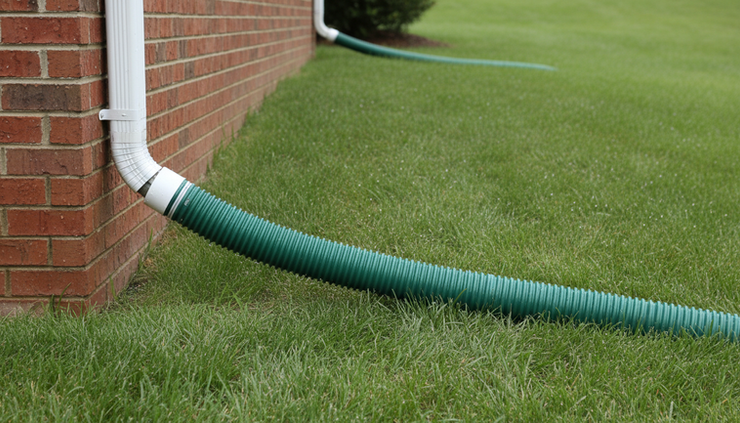
Better ways to handle downspout discharge
The right solution depends on the site, climate, soil, and roof size. Still, most homes benefit from one or more of these practical fixes.
Add downspout extensions
A simple above-grade extension is often the fastest improvement. It should carry water well away from the foundation and release it where the ground slopes away.
Use splash blocks correctly
Splash blocks help reduce erosion at the discharge point, but they must slope away from the house. A splash block tilted toward the foundation makes the problem worse.
Install buried drain lines with care
Underground drain lines can work well when properly sloped and daylighted to a safe location. They also need maintenance access. A buried pipe that clogs can back up and dump water at the foundation again.
Create or restore positive grading
Soil should not be piled against siding or weep holes, but low areas near the foundation should be corrected. Grading should direct surface water away from the structure.
Keep planting beds lower and drier near the house
Foundation plantings should not require constant watering against the wall. Leave space for inspection, airflow, and maintenance. Avoid building raised beds that trap water against the foundation.
Signs that downspout drainage is causing trouble
Look for clues during or after rain. The problem is often visible if the area is checked at the right time.
Common warning signs include:
Water pooling in mulch near the foundation
Soil erosion below downspout elbows
Mulch washed away in a narrow path
Damp basement corners below downspouts
Efflorescence on masonry walls
Musty crawlspace odors
Settled soil beside the foundation
Mosquito activity in soggy planting beds
Downspout extensions that are missing, crushed, or disconnected
A dry day can hide drainage defects. A rainy day often reveals them.

The best drainage is simple and visible
Proper downspout drainage does not need to be complicated. In many cases, the fix is as basic as reconnecting an extension, correcting the slope of a splash block, or moving discharge out of a planting bed.
The key is remembering what the system is supposed to do. Gutters and downspouts exist to protect the home, not water the landscaping. Flower beds against the foundation already receive rain and may receive irrigation. They do not need concentrated roof runoff added to the mix.
Keep downspouts extended, keep soil sloped away, and keep foundation beds from becoming hidden reservoirs. That simple habit can help reduce moisture problems and protect the structure over the long term.


Comments