
Why Venting Crawlspaces Causes Moisture Mold and Structural Damage

A vented crawlspace sounds logical at first. Openings in the foundation should let damp air escape, right? In many U.S. climates, the opposite happens. Outdoor air enters the crawlspace, cools down, and drops moisture onto wood, insulation, ducts, and soil.
That moisture can lead to mold growth, wood rot, pest activity, poor indoor air quality, and structural damage. For many homes, a sealed crawlspace is the safer, drier, and more durable choice.
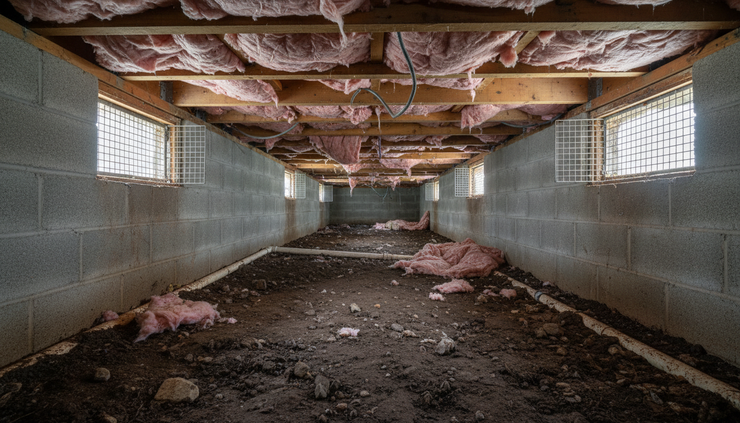
Why old crawlspace advice often fails
For decades, building codes and common practice treated crawlspace vents as a simple moisture fix. The idea came from the belief that airflow would dry the space under the house.
That approach works only when the outside air is dry enough to remove moisture. In humid areas, especially during spring and summer, venting can bring in air that contains more water vapor than the crawlspace can handle.
Building science experts now recognize this problem. The U.S. Department of Energy has published guidance supporting sealed and conditioned crawlspaces in many climates when they are properly detailed. Building Science Corporation and other building enclosure specialists also commonly recommend sealed crawlspaces because they control moisture at the source instead of hoping outdoor air will solve it.
The International Residential Code also allows unvented crawlspace assemblies when they meet requirements for ground vapor barriers, insulation, and air sealing. That matters because sealed crawlspaces are no longer an unusual idea. They are a recognized construction method when done correctly.
Vents can make moisture worse
A crawlspace is cooler than the air outside for much of the year. When warm, humid outdoor air enters through vents and touches cooler surfaces, its relative humidity rises. If the surface is cold enough, the moisture can condense.
That is why vented crawlspaces often show:
Damp wood framing
Wet or compressed insulation
Condensation on ductwork
Musty odors
Rust on metal fasteners, pipes, and HVAC parts
Standing water or muddy soil after rainy periods
The soil below the house adds another source of moisture. Bare ground constantly releases water vapor. Vents do not stop that vapor. In humid weather, they can add even more moisture from outside.
Research and field experience in mixed-humid and humid climates have consistently found that sealed crawlspaces tend to stay drier than vented ones when they include a durable ground vapor barrier and controlled air management.
That does not mean every crawlspace has the same moisture risk. Climate, drainage, grading, foundation type, and HVAC layout all matter. Still, the physics are clear. Venting is not moisture control if the air coming in is wet.

Mold does not need much to grow
Mold needs moisture, organic material, and time. A crawlspace often provides all three. Wood framing, paper-faced insulation, cardboard debris, and dust can all support mold when humidity stays high.
The Environmental Protection Agency gives a simple rule for mold prevention: control moisture. That applies directly to crawlspaces. If vents raise humidity or allow condensation, they create the conditions mold needs.
Mold in a crawlspace is not just a problem under the house. Air moves upward through many homes because of stack effect, duct leakage, and small gaps around plumbing, wiring, and framing. This means crawlspace air can enter living areas.
A musty smell in rooms above the crawlspace is often a sign that air from below is finding its way inside. Sealing the crawlspace helps reduce that source of damp, moldy air.
Common mold trouble spots include:
Rim joists and band joists
Floor sheathing above the crawlspace
Fiberglass insulation
Duct boots and air handler cabinets
Wood near foundation vents
Areas around plumbing penetrations
A sealed crawlspace does not magically remove existing mold. Any active growth should be assessed and cleaned using safe methods. The bigger point is prevention. Keep the space dry, and mold has a much harder time returning.
Wood rot and structural damage start with dampness
Structural damage usually starts quietly. Wood does not need to be soaked to suffer. Long-term elevated moisture can weaken framing, invite fungi, and attract wood-damaging pests.
Floor joists, sill plates, beams, and subflooring are all vulnerable in a damp crawlspace. Over time, moisture can lead to:
Soft or crumbling wood
Sagging floors
Loose fasteners
Rusted metal connectors
Termite or carpenter ant activity
Damaged insulation and higher energy bills
The risk is not limited to older homes. Newer homes with tight construction can still have foundation vents, exposed soil, and ducts in the crawlspace. If the crawlspace stays wet, the structure pays the price.
Pest control professionals often look for moisture first because many pests prefer damp environments. Removing the moisture source makes the crawlspace less inviting.

Why sealed crawlspaces perform better
A sealed crawlspace works by separating the under-house area from outdoor humidity and ground moisture. It treats the crawlspace as part of the home enclosure rather than as an outdoor space.
A healthy sealed crawlspace usually includes:
A continuous ground vapor barrier Thick polyethylene or reinforced liner covers the soil and is sealed at seams, piers, and foundation walls.
Closed foundation vents Vents are sealed to stop humid air from entering.
Air sealing Gaps around pipes, wiring, sill plates, and penetrations are sealed to reduce air movement.
Insulated crawlspace walls In many homes, insulating the foundation walls works better than insulating between floor joists.
Drainage control Gutters, downspouts, grading, and perimeter drainage keep bulk water away from the foundation.
Conditioned or dried air Some sealed crawlspaces use a small supply of conditioned air, a dehumidifier, or another approved drying method.
The result is a more stable environment. Wood stays drier. Ducts work in less extreme conditions. Floors may feel warmer in winter. Indoor air can smell fresher because the home is no longer pulling as much damp air from below.
Practical tips for a healthier crawlspace
Start with water. No crawlspace system can perform well if rainwater drains toward the foundation or groundwater collects under the house.
Check these areas first:
Make sure gutters are clean and working.
Extend downspouts several feet away from the foundation.
Slope soil away from the house where possible.
Repair plumbing leaks right away.
Remove wet insulation, cardboard, and stored debris.
Cover exposed soil with a sealed vapor barrier.
Seal gaps around ducts, pipes, and wiring.
Keep wood framing separated from standing water and wet soil.
Monitor humidity with a simple hygrometer.
Aim to keep crawlspace relative humidity low enough to discourage condensation and mold.
If a crawlspace already has mold, rot, or standing water, get a qualified crawlspace, foundation, or building performance professional to inspect it. Sealing a wet crawlspace without fixing drainage can trap a bulk water problem inside.

The better crawlspace strategy is control
Vented crawlspaces depend on outdoor air behaving perfectly. In humid weather, it often does not. The vents that were meant to dry the space can bring in the moisture that feeds mold, damages insulation, rusts metal, and weakens wood.
A sealed crawlspace gives the house more control. It blocks ground vapor, reduces humid air entry, supports better drying, and protects the structure above it. For many homeowners, that makes sealing the crawlspace one of the most valuable steps toward a drier, healthier, longer-lasting home.


Comments